
Multiplayer VR Theatre
ShemarooVerse
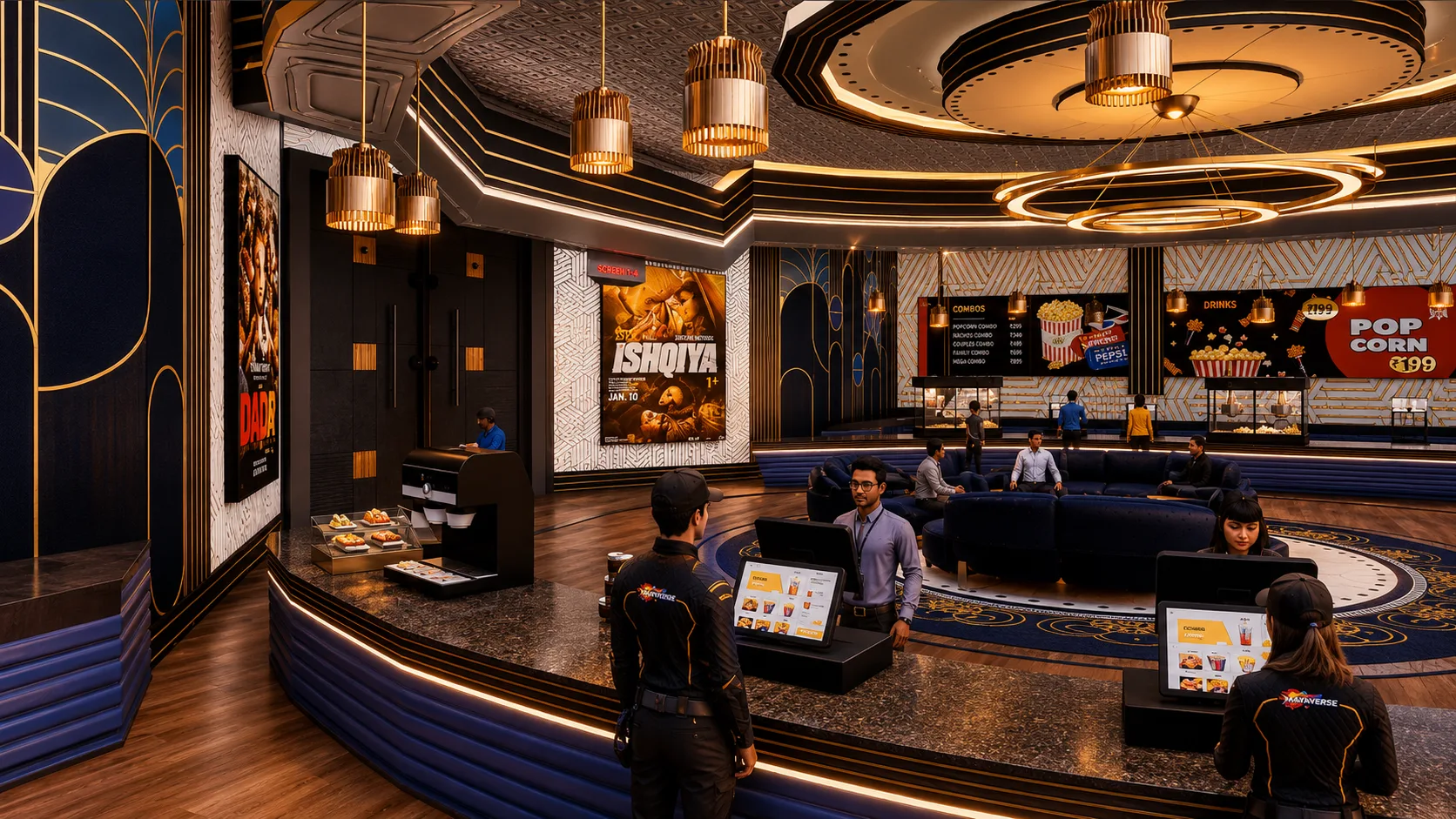
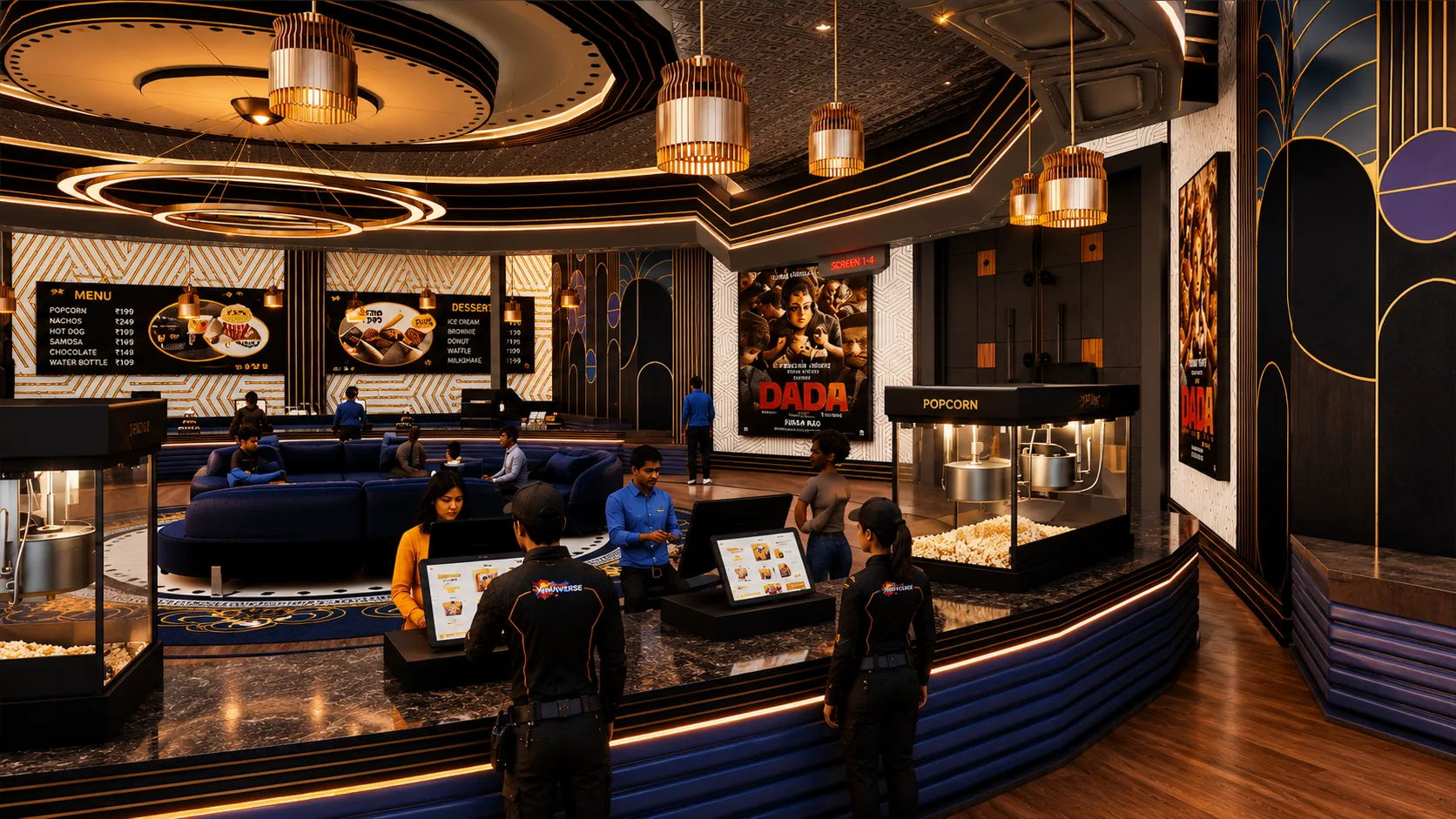
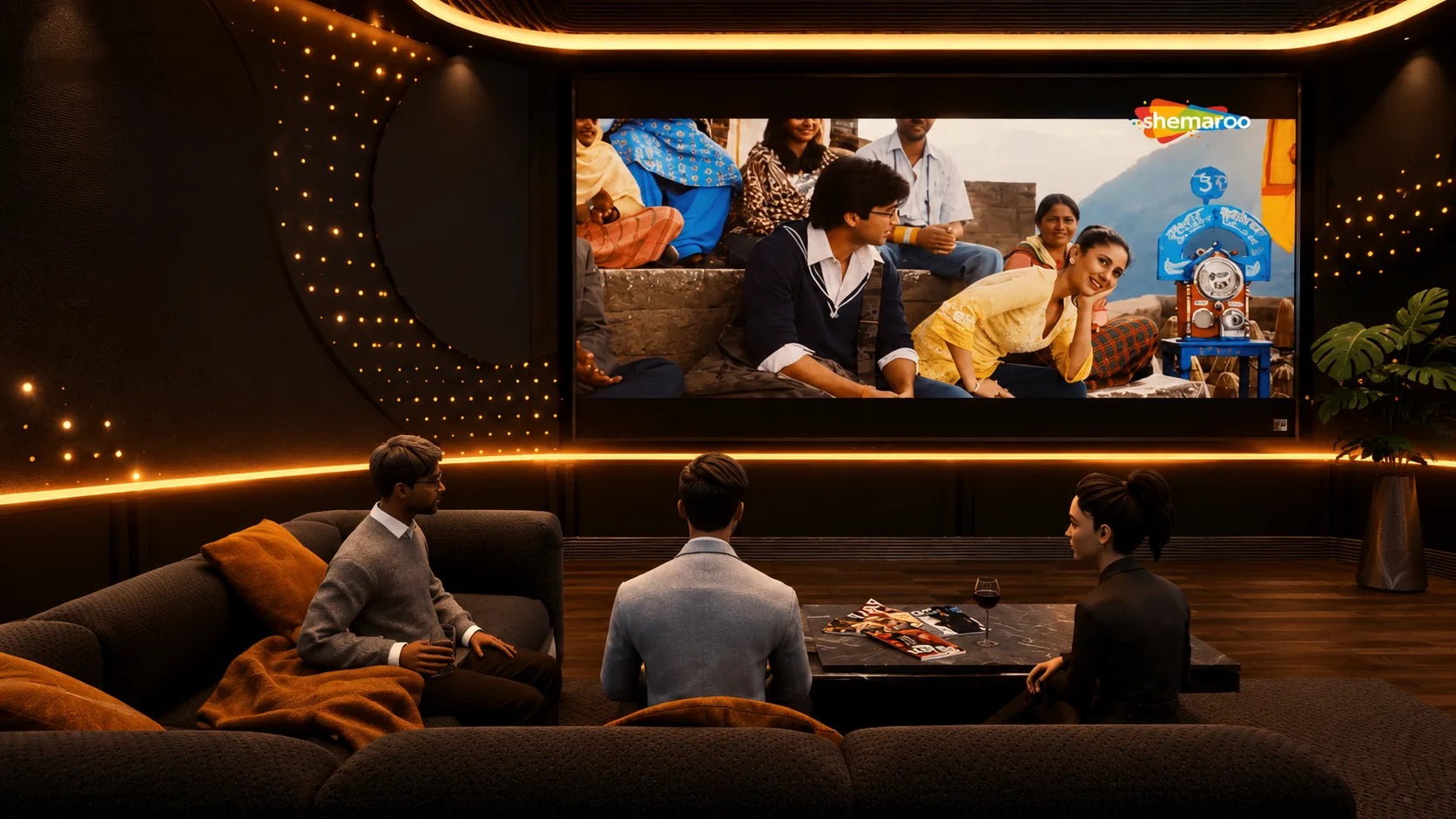
A commercial-grade multiplayer VR theatre experience developed for JioDive and JioGlass devices. Watch OTT content with friends in a shared immersive space.
Multiplayer Cinema
Real-time room matching and frame-accurate playback synchronisation powered by Photon Fusion networking.
Spatial Voice Chat
High-quality directional audio communication with acoustic falloff configured for virtual theatre spaces.
Hands-Free Navigation
Reliable gaze-based user interaction with optimized dwell-time thresholds designed for mobile VR comfort.
Shared Virtual Cinema
ShemarooVerse transforms traditional, passive OTT viewing into a shared social event. Users authenticate via a secure REST API to retrieve their subscription entitlement before entering a persistent lobby.
Built for Reliance Jio's head-mounted display ecosystem (JioDive & JioGlass) running on Android, the application integrates the JMR SDK and AVPro Video Player to decode and render immersive 360° videos smoothly on mobile chipsets.
State-Synchronised World
At the heart of the experience is a robust synchronization layer. Gaze input and UI hover highlights are kept local for lag-free visual response, while state-changing events (like starting content, pausing, or seeking) are mediated via a Host-Authoritative model in Photon Fusion.
Photon Voice operates on a parallel, dedicated audio channel, utilizing Voice Activity Detection (VAD) and custom spatial audio falloff to create a natural, lifelike conversation environment inside the virtual theatre.
- Host-Authoritative Playback Actions
- Dynamic Spatial Audio Chat & Echo Cancellation
- Hands-Free Dwell-Time Interaction Machine
Optimized Mobile VR Deployment
To deliver frame-rate critical multiplayer entertainment on standalone Android VR devices, the build enforces strict heap controls and limits rendering draw calls via static batching.
| Platform Feature | Implementation Detail |
|---|---|
| Target Devices | JioDive • JioGlass (Android Mobile VR) |
| Networking SDK | Photon Fusion (State-Sync) + Photon Voice (Spatial Audio) |
| Video Decoding | AVPro Video player with Android hardware acceleration |
| Integration SDK | JMR SDK (Reliance Jio native interface) |
Let's Design Your Project
We engineer modular, production-ready interactive systems, spatial networking layers, and optimized VR pipelines. Reach out to our engineering team to bring your vision to life.
Start Your ProjectShemarooVerse
Multiplayer VR Theatre Architecture
A deep-dive into the engineering, architecture, and technical problem-solving behind a commercial-grade multiplayer VR theatre experience built for Jio's proprietary head-mounted display ecosystem.
Socialising Immersive OTT
ShemarooVerse On Jio Immerse is a fully immersive, multi-user VR entertainment experience developed for the JioImmerse platform. The application transforms passive OTT streaming into an interactive social event, allowing users to enter a virtual theatre, watch immersive 360° video streams together, and converse in real time using directional voice chat.
The system targets Android-based mobile VR (JioDive and JioGlass), relying on Reliance Jio's proprietary VR ecosystems. Built as a social cinema, the platform guarantees that spontaneous reactions and shared moments are synchronized globally across real-world network variations.
Technical Specifications
| Platform & Engine Details | |
|---|---|
| Platform | JioDive • JioGlass (Android Mobile VR) |
| Engine | Unity |
| SDKs & Plugins | JMR SDK • Photon Fusion • Photon Voice • AVPro Video |
| Genre & Mode | Multiplayer Shared Virtual Cinema / Immersive OTT |
| Core Tech | Gaze Interaction, REST API, 360° Video, Voice Chat |
Application Summary
| Aspect | Detail |
|---|---|
| Core Experience | Shared virtual theatre for Shemaroo OTT content |
| User Action | Navigate virtual space, select content, watch together |
| Multiplayer | Multiple simultaneous users in a shared VR room via Photon Fusion |
| Voice Chat | Real-time spatial voice communication between users via Photon Voice |
| Content Delivery | Secure OTT streaming via REST API integration |
| Video Format | 360° immersive video via AVPro Video Player |
| Input Method | Gaze-based interaction (head-mounted display) via JMR SDK |
The Multiplayer OTT Stack
ShemarooVerse is architectured with a layered design pattern: hardware/OS abstractions are handled by the JMR SDK and Photon network, while custom Unity singletons drive gameplay loop state, user inputs, and REST endpoints.
High-Level Layer Architecture
| Layer | Responsibility |
|---|---|
| Hardware / OS Layer | JioDive / JioGlass Android runtime, sensor fusion, 3DoF/6DoF head tracking |
| JMR SDK | Device optimization, VR rendering, display lens corrections for Jio hardware |
| Photon Fusion | Real-time room management, state synchronization, client RPCs |
| Photon Voice | Low-latency, spatialized voice communication with Voice Activity Detection (VAD) |
| Unity Engine | Render pipeline, scene management, Canvas UI, audio systems |
| AVPro Video Player | Highly optimized equirectangular 360° video decoding on mobile GPU |
| REST API Layer | Authentication, user subscriptions, content catalog retrieval, secure CDN URL resolution |
| Custom Game Systems | GazeInteractionManager, UIController, ContentManager, SessionManager, AvatarController |
Core Unity Systems
GazeInteractionManager
Responsible for all user input in the application. Casts a gaze ray from the headset's forward vector and performs raycasts against interactive UI elements and world objects. Implements dwell-time activation (gaze-hold for configurable duration) to trigger selections, providing reliable hands-free interaction without physical controllers.
SessionManager
Manages the Photon Fusion network lifecycle — room creation, joining, leaving, and graceful disconnect handling. Synchronises session state (which content is playing, playback position, user list) across all connected clients using Photon's state synchronisation primitives.
ContentManager
Handles all communication with the backend REST APIs — authentication, catalogue retrieval, stream URL resolution, and entitlement verification. Passes validated stream URLs to AVPro Video Player for 360° playback initiation.
AvatarController
Manages remote user avatar representation in the shared space. Receives networked head transform data via Photon Fusion and applies it to avatar rigs, giving remote users visible presence and directional context during voice conversations.
Engineering Brand & Network Synchronization
Gaze-Based Input Synchronization
Local Gaze vs. Networked Authority
Gaze vectors are entirely local to individual HMDs. In a multiplayer theater, one user's drift can cause conflicting UI highlights. Additionally, accidental dwelling could trigger playback commands globally, disrupting others.
Host-Authoritative Gaze RPCs
We implemented a Host-Authority topology. Local dwell-time completes at 1.5 seconds, sending a request RPC to the session host. Only the host updates the shared session state, preventing conflict. Interactive zones use dual-radius loops (inner activation, outer cancel) to accommodate micro-drifts.
Mobile VR Performance Limits
Thermal Throttling & Draw Calls
JioDive and JioGlass are powered by Android mobile SOCs with tight thermal constraints. Concurrent 360° video decoding, multiple player avatar meshes, and network processing drop framerates below the 60 FPS comfort threshold.
Tiered Rendering & Tick-Rate Caps
We optimized the 360° video rendering onto a low-polygon equirectangular SphereMesh. Remote avatars use an LOD system and tick at 15Hz. We enabled Fixed Foveated Rendering and customized Jio-specific lens distortion shaders via JMR SDK, compiling in native ARM64 IL2CPP.
Video Desync Across Mobile Connections
Jitter & Buffering Gaps
Real-world mobile connections (4G/Wi-Fi) suffer from high jitter. Clients buffering independently caused their local timelines to slip, resulting in players watching different parts of the same stream.
NTP Host-Anchor & Pause Loops
We created `SyncedVideoController` which syncs client clocks using Photon's network time. If a client drifts beyond 0.5 seconds of the host, it seeks silently. If any client enters a buffering state, it notifies the host, which halts playback for all players and resumes when all report ready.
OTT DRM Security & Entitlements
Token Expiry in Immersive Spaces
Integrating secure OTT channels inside Unity requires token-based authentication. If token refresh or URL fetching triggers blocking web dialogs, it breaks immersion and closes the VR application runtime.
Background JWT Refresh Lifecycle
An async `APIManager` handles API communication off the main thread. Tokens are refreshed silently in-memory at 80% TTL. Temporary stream URLs are re-fetched 60 seconds before expiration without pausing playback, mapping any connection errors to floating peripheral alerts.
Networking & Voice Topography
To ensure social presence is comfortable and lag-free, Photon Voice and Photon Fusion run on independent data threads.
Photon Fusion Network Topology
| Component | Role |
|---|---|
| Room Host | Authoritative game state, video synchronization, room event management |
| Photon Cloud | Relays RPC calls, matchmaking lobby management, room discovery |
| NetworkObject | Synchronized elements (e.g. avatars, video controller state, UI sync panels) |
| RPC System | Sends local user play, pause, seek triggers to Host; issues notifications |
| State Sync | Low-overhead synchronization of player position transforms and room catalogs |
| Photon Voice | Handles direct audio stream compression, transport, and decoding |
Gaze Interaction State Machine
| State | Transition Logic |
|---|---|
| IDLE | No interactive canvas inside gaze ray. Cursor renders as a neutral central dot. |
| HOVERING | Gaze ray hits interactive object. Visual cursor animates. Dwell timer begins. |
| DWELLING | Gaze held inside element zone. Progress ring fills over 1.5s. Exits if gaze drifts. |
| ACTIVATED | Dwell timer completes. Local feedback plays; request RPC is sent to Host. Returns to IDLE. |
| BLOCKED | Host rejects request (e.g., non-admin seeks). Rejection animation triggers. Returns to IDLE. |
Voice Chat Architecture
- Runs on a dedicated UDP audio channel to preserve network bandwidth for state synchronization.
- Voice Activity Detection (VAD) prevents idle room noise from broadcasting.
- Spatial audio attenuation curves map to physical VR theater dimensions, rendering player voices relative to avatar coordinates.
- Echo cancellation enabled via Jio's HMD microphone integration within the JMR SDK.
Validation & Takeaways
Host Authority Solves Gaze Conflict
Gaze-based hands-free selection is highly responsive but prone to accidental double-triggers. Decoupling hover feedback from execution via host verification prevents race conditions and makes UI actions reliable.
Target Hardware Profiling is Paramount
On mobile HMDs like JioDive, 360° video decoding takes nearly 30–40% of the overall GPU budget. Code optimization must be performed on-device via ADB and Android GPU Inspector from day one, not retrofitted at the end.
Video Sync is a Distributed Clock Challenge
Achieving shared cinema playback requires synchronizing to a single clock timeline. A host-anchored network timestamp with dynamic, silent drift correction (under 0.5 seconds) is far more stable than trying to sync individual video frames.
HMD SDK Customizations are Non-Negotiable
Standard Android builds do not output correct lens distortion parameters or handle display refresh cycles for JioDive and JioGlass. Tight integration of the JMR SDK is essential to provide comfortable, motion-sickness-free viewing.
Photon Fusion + Photon Voice are Highly Compatible
The host-client model maps perfectly onto shared media environments. Keeping the audio transport channel isolated from the game state keeps networking traffic efficient and clean.
Proactive Security Refresh Maintains Immersion
DRM authentication and token cycles must run silently in the background. Interrupting a movie stream with a blocking login popup breaks user presence. Proactive refresh cycles are the correct way to handle secure OTT in VR.
Social Presence is the Product
User testing consistently proved that hearing a friend's voice and turning to see their avatar was the primary reason to choose VR OTT over standard mobile displays. Presence quality beats visual fidelity for social VR applications.
Ready to Build Your Immersive Vision?
DualCore Games specializes in multiplayer VR engineering, JMR SDK development, and secure OTT streaming platforms. Let's build together.