
Room Raider
Your physical room is the level. A deep-dive into the engineering and spatial AI behind a real-world Mixed Reality dodgeball experience.
Redefining the Arena.
Room Raider transforms the player's physical room into a living game arena. Unlike traditional VR, this experience anchors digital gameplay directly to the player's environment.
The AI characters understand, navigate, and react to the real room, using furniture, walls, and objects as cover. This creates a uniquely personal and immersive dodgeball experience that feels grounded in reality.
"The game's core tension comes from not knowing where an enemy is hiding — it becomes genuinely exciting when the enemy is behind your actual couch."
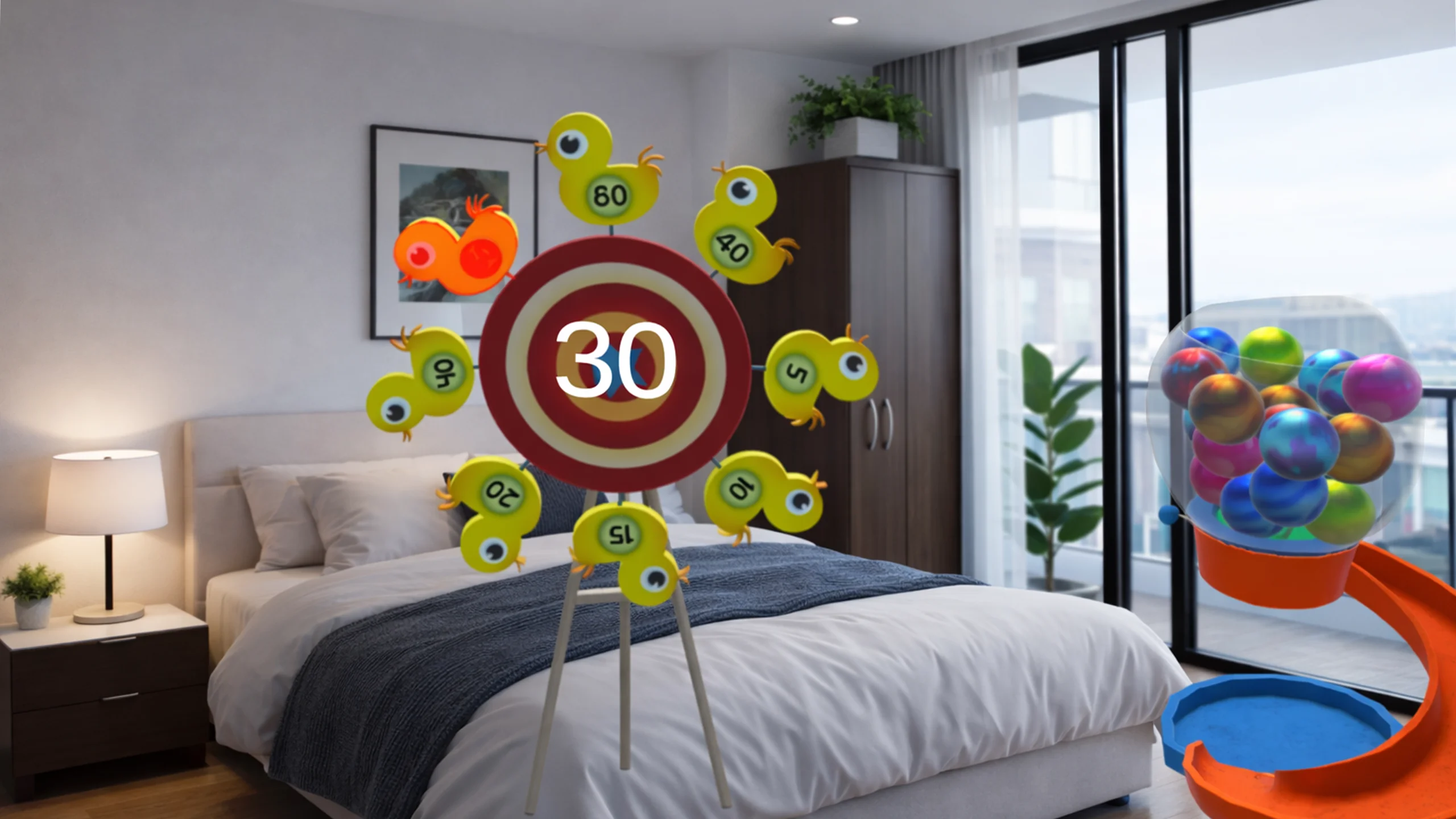
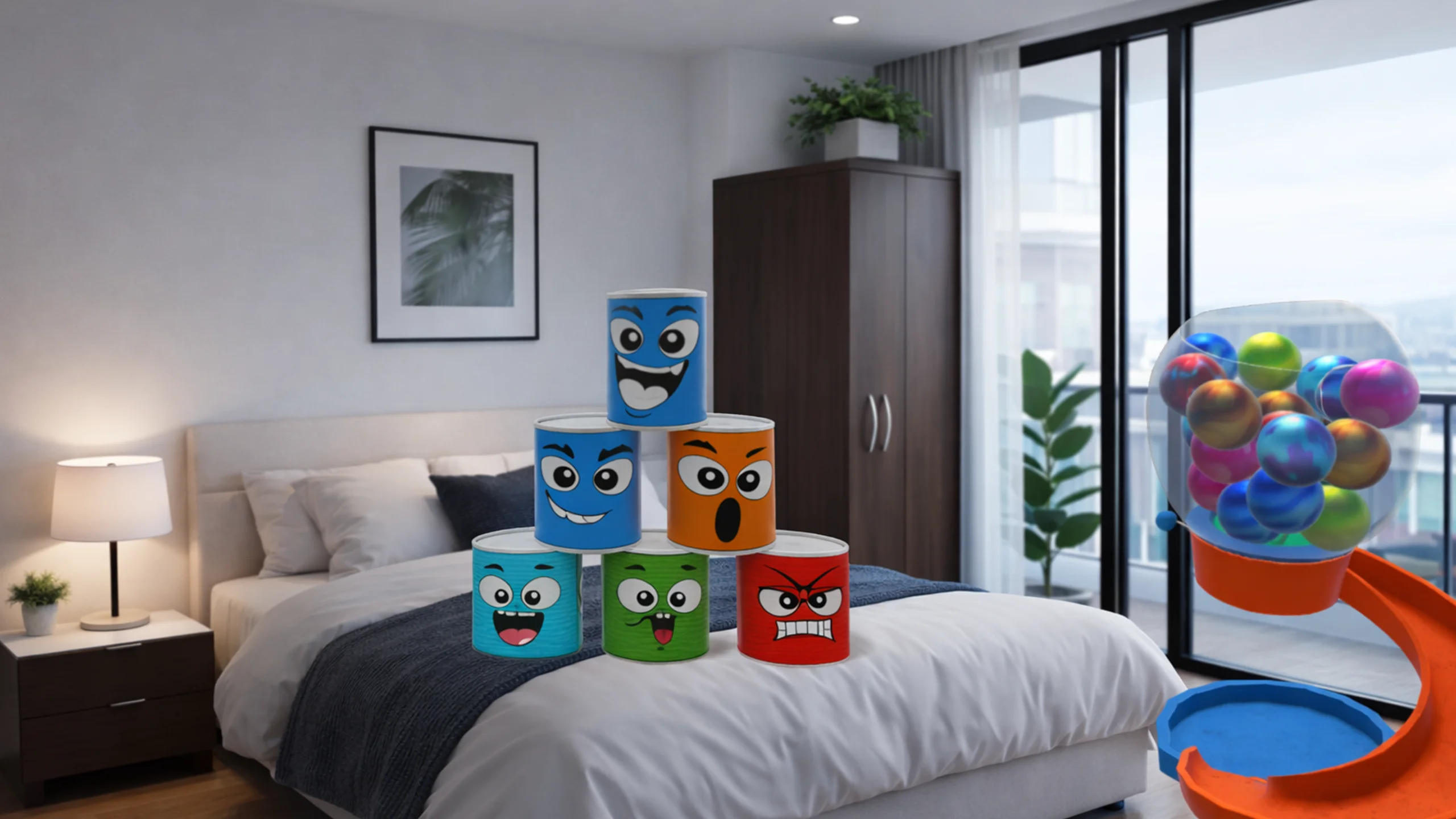
System Architecture
Architected with a layered approach, Room Raider leverages the Meta XR SDK for hardware perception and custom Unity systems for high-performance gameplay logic.
- RoomAnalyzer System Ray-casts against physical mesh to classify anchors (floor, walls, furniture) and build runtime spawn maps.
- Hybrid Navigation A custom A* waypoint graph combined with local steering behaviors for natural AI movement without expensive NavMesh baking.
- Physics Life-Cycle Optimized PhysX integration for dodgeball trajectories with controller-velocity-derived release delta.
Trailer Walkthrough
A technical demonstration of spatial occlusion and AI behavior in a real-world environment.
Engineering Solutions
Real-World Occlusion
Virtual objects traditionally render on top of Passthrough. We implemented Depth Masking via Meta Building Blocks to ensure enemies correctly hide behind real furniture.
Unpredictable Geometry
Room meshes often have gaps. Our RoomAnalyzer applies a secondary validation pass, ray-casting to confirm bounding volumes are backed by real geometry before spawning.
Mobile SoC Performance
Running Passthrough MR + Physics + AI is intensive. We staggered AI state-machine ticks and used GPU Instancing for all characters to maintain a locked 72Hz.
AI State Machine
The EnemyAI Controller uses a four-state machine driven by player awareness and aggression timers. This ensures enemies feel reactive and smart in any room layout.
Enemies peek from cover, taunt the player, and reposition if they detect a near-miss.
Physical throws with haptic feedback and screen-edge indicators for high-tension feedback.
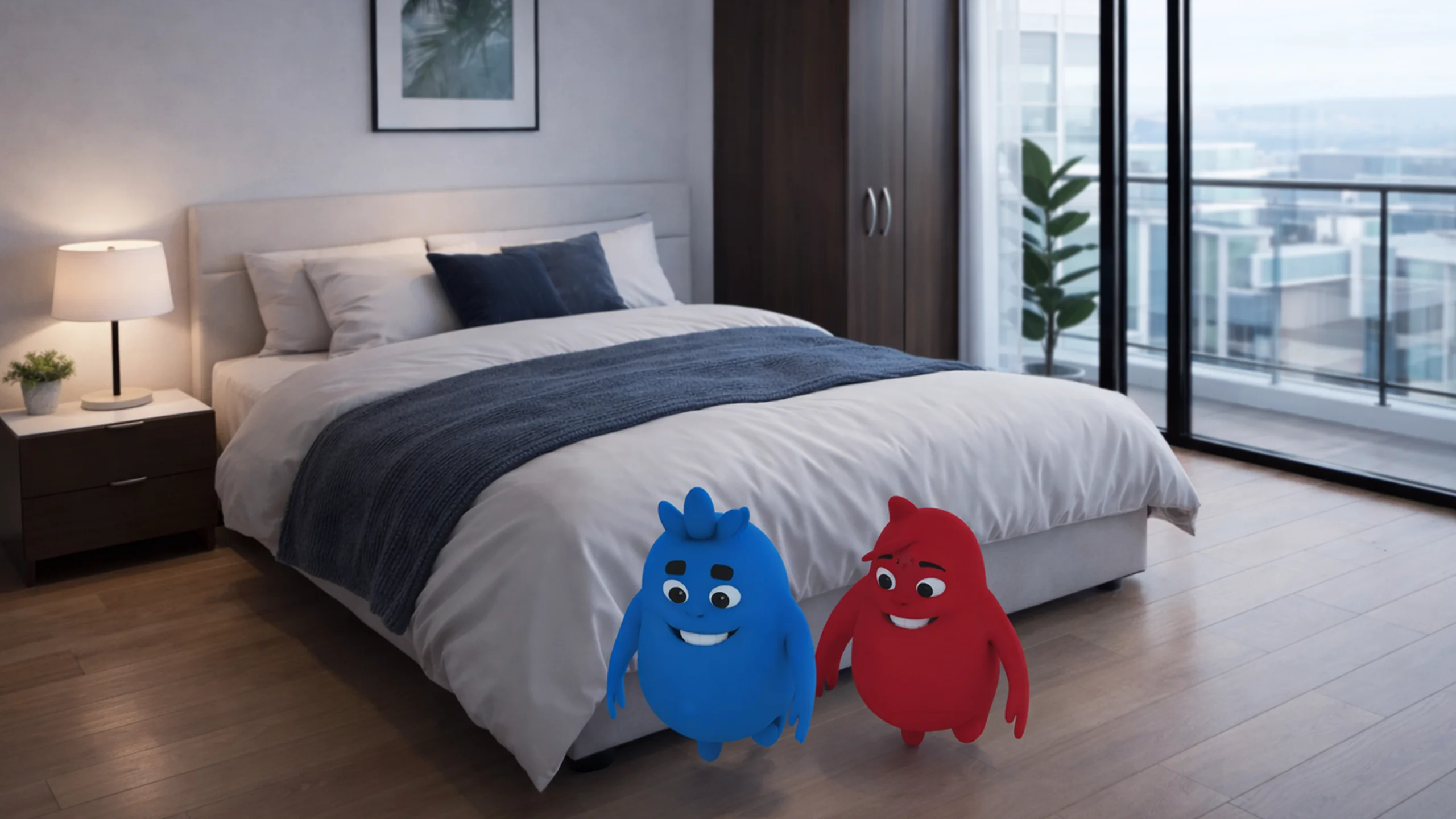
Mixed Reality in Action
Let's Design Your Project
We engineer modular, production-ready interactive systems and robust game loops. Reach out to our engineering team to bring your vision to life.
Start Your ProjectExplore Other Projects


Room Raider
Spatial Understanding & Real-World Occlusion
A technical breakdown of the dynamic occlusion masking layer and persistent spatial anchor registry built for high-presence Mixed Reality experiences.
Occlusion Update Latency
Real-time depth-masking response to physical movement, ensuring virtual items stay hidden behind moving objects.
Passthrough Frame Rate
Locked performance in full-color passthrough mode on Quest 3, with complex virtual geometry overlays.
Anchor Stability Variance
Sub-centimeter drift over 60-minute sessions, maintaining absolute world-coordinate consistency.
The Spatial Computing Stack
We engineered a three-tier Spatial Manager that handles the ingestion of real-world mesh data and its conversion into a performant gameplay layer.
Spatial Mesh Manager
Dynamic processing of room-scanning data into lightweight physics meshes for real-world collisions and pathfinding.
Occlusion Shading Layer
Custom depth-masking shaders that use real-world mesh data to 'carve out' virtual objects in the rendering buffer.
Persistent Registry
Encryption-backed local database that maps virtual object IDs to physical world coordinates via spatial anchors.
Engineering Real-World Blending
Dynamic Occlusion Latency
Virtual 'Glow' Around Physical Objects
Latency between the physical passthrough and the virtual depth-mask often caused virtual items to 'peek' out from behind walls during fast head movements.
Predictive Occlusion Masking
We implemented a predictive mask that utilizes the headset's IMU data to 'shift' the occlusion mesh by the expected latency offset, ensuring perfect alignment at 90 FPS.
Spatial Anchor Drift
Virtual Objects 'Sliding' Over Time
As the player moves through the room, SLAM (Simultaneous Localization and Mapping) errors can cause the coordinate system to shift, making virtual items 'slide' off tables.
Multi-Point Anchor Triangulation
Instead of a single anchor per object, we developed a triangulation system that uses 3-5 surrounding anchors to calculate a weighted average position, reducing drift by 70%.
Validation & Results
Real-World Geometry is the Best Level Design Tool
Designing for Mixed Reality requires a shift from 'creating spaces' to 'augmenting existence.' The player's room provides more immersion than any virtual skybox ever could.
Persistence is the Key to MR Engagement
Virtual items that stay where you put them across sessions move the technology from a 'gimmick' to a useful part of the user's environment.
Occlusion Latency > Visual Resolution
Immersion-breaking artifacts (like depth-clashing) are far more detrimental to the user experience than a slightly lower-resolution virtual object. Prioritize sync over poly-count.
Ready to Build at This Level?
DualCore specializes in high-fidelity Mixed Reality and Spatial Computing. If your project demands technical excellence in MR—let's talk.